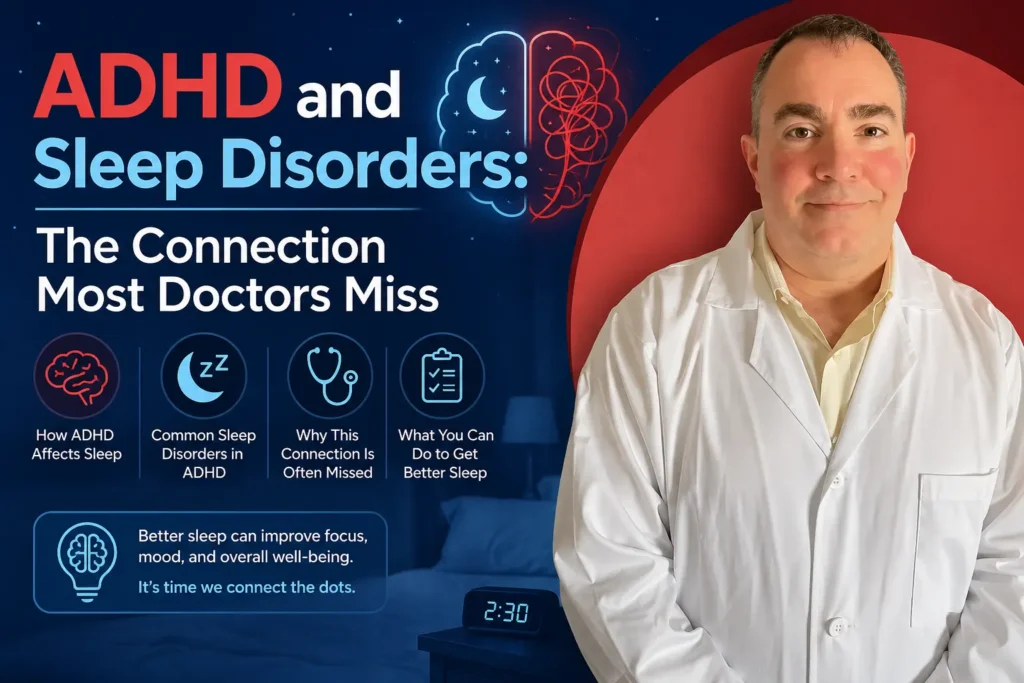
In my Trenton, NJ psychiatric practice, almost every adult patient I evaluate for ADHD has sleep problems. This is not a coincidence. The relationship between ADHD and sleep disorders is deep, bidirectional, and significantly underappreciated, even among clinicians who treat one or the other condition.
I am in an unusual position to address this: I hold board certifications in both psychiatry (including neuropsychiatry) and sleep medicine. This dual expertise is not incidental to my ADHD practice, it shapes how I evaluate and treat every patient who presents with attention difficulties, because sleep and ADHD are neurologically intertwined in ways that matter enormously for treatment outcomes.
How Common Is Sleep Disruption in ADHD?
Very common. Research suggests that 25–50% of children with ADHD have significant sleep problems, and the rates in adults are even higher. The most frequent sleep difficulties in ADHD include:
- Delayed Sleep Phase: A pattern of falling asleep significantly later than desired (often 1–3 AM), waking late, and struggling to function in the morning. This is one of the most consistent sleep findings in ADHD and is thought to reflect dysregulation of the circadian clock.
- Difficulty falling asleep: Racing thoughts and mental hyperactivity at bedtime make it hard to disengage and settle into sleep.
- Restless sleep and frequent waking: The ADHD nervous system’s tendency toward hyperarousal often continues during sleep.
- Restless Legs Syndrome (RLS) and Periodic Limb Movements: Both are significantly more common in people with ADHD than in the general population, and both disrupt sleep architecture.
- Sleep apnea: While not caused by ADHD, sleep apnea occurs in adults with ADHD at rates higher than the general population. Untreated sleep apnea produces daytime inattention and cognitive impairment that can mimic and worsen ADHD.
Why ADHD and Sleep Are Neurologically Linked
The connection is not coincidental. ADHD involves dysregulation of the dopaminergic and noradrenergic systems in the prefrontal cortex, and these same systems are involved in the regulation of the sleep-wake cycle. The circadian system, which governs the timing of sleep, relies on dopaminergic signaling. When dopamine regulation is abnormal, as it is in ADHD, circadian rhythm disruption follows.
Additionally, the melatonin onset in people with ADHD is often delayed by 1.5 hours or more compared to neurotypical individuals. This is not a behavioral preference or poor sleep hygiene, it is a physiological difference that makes early sleep genuinely difficult and early morning functioning genuinely impaired.
How Sleep Problems Worsen ADHD
This is where the relationship becomes a cycle. Poor sleep actively worsens ADHD symptoms:
- Sleep deprivation reduces prefrontal cortex activity, the same region that is already functionally underactive in ADHD
- Inattention, impulsivity, and emotional dysregulation all worsen measurably after even one night of insufficient sleep
- Chronic sleep debt compounds over time, producing a baseline of impairment that makes ADHD substantially harder to manage
Many patients I see have their ADHD symptoms largely explained by chronic sleep deprivation from unrecognized delayed sleep phase or untreated sleep apnea. When sleep is treated, some of what appeared to be treatment-resistant ADHD improves substantially.
ADHD Medications and Sleep: An Important Consideration
Stimulant medications for ADHD can worsen sleep when taken too late in the day. This is one of the most frequent medication management issues I address:
- Immediate-release stimulants (Ritalin, Adderall IR) typically last 4–6 hours. Taking a dose after noon can delay sleep onset.
- Extended-release formulations provide more consistent coverage but must be timed appropriately for the individual’s schedule.
- Evening doses of any stimulant are generally avoided unless specifically indicated.
Conversely, some stimulant medications, at carefully selected doses, can paradoxically help some patients with ADHD sleep better by reducing the mental hyperactivity that keeps them awake. This is a counterintuitive but well-documented phenomenon.
Non-stimulant options like guanfacine and clonidine have sedating properties and may be particularly useful for ADHD patients with prominent sleep difficulties, particularly for the hyperarousal component.
My Approach: Treating Both Together
Because I am trained in both psychiatry and sleep medicine, I evaluate sleep as a co-equal component of ADHD treatment, not an afterthought. My approach includes:
- Detailed sleep history as part of every ADHD evaluation: timing of sleep, quality, daytime fatigue, snoring, leg movements, and morning functioning
- Assessment for delayed sleep phase and, when indicated, recommendations for circadian adjustment strategies including light therapy and melatonin timing
- Referral for sleep study when sleep apnea or periodic limb movement disorder is suspected
- Medication timing recommendations that account for sleep effects
- CBT-I (Cognitive Behavioral Therapy for Insomnia) referral when behavioral insomnia is present
A patient who comes to me with poorly controlled ADHD despite adequate medication trials should always have their sleep evaluated. In my experience, unaddressed sleep disorders are one of the most common reasons why ADHD treatment produces less improvement than expected. |
The Unique Advantage of Dual Expertise
Most psychiatric practices refer sleep concerns to a separate sleep specialist. In my practice, I can evaluate and address both conditions together, with direct knowledge of how they interact and how treatment of one affects the other. This integrated approach avoids the fragmentation that can occur when sleep is treated in one place and psychiatry in another, and it allows for a more coherent, comprehensive treatment plan.
If you have ADHD and sleep problems, whether recognized or not, addressing both together is likely to produce better outcomes than treating them separately.
Dr. David Bresch, MD is board-certified in psychiatry, neuropsychiatry, AND sleep medicine, uniquely positioned to treat ADHD and sleep disorders together. Serving Trenton, NJ and all of New Jersey via TelePsychiatry. Medicare and commercial insurance accepted. Call (609) 588-0250. |