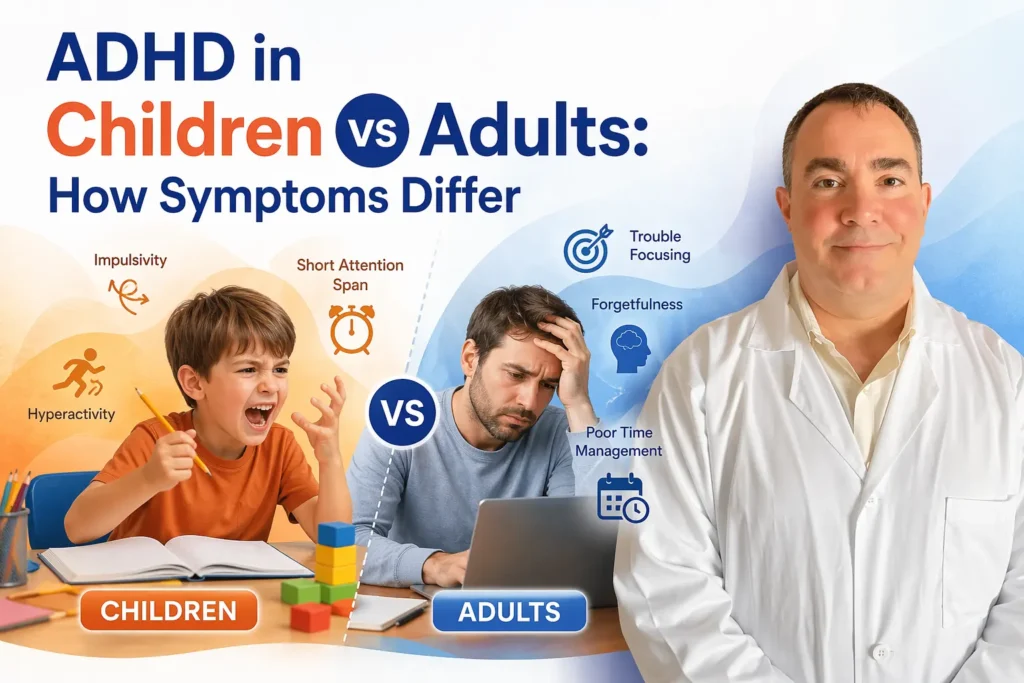
One of the most important things I explain to patients and parents in my Trenton, NJ practice is this: ADHD is the same underlying condition across the lifespan, but it expresses itself very differently depending on age. What looks like a hyperactive, impulsive child in elementary school may become a restless, disorganized, emotionally intense adult. Without understanding this developmental shift, ADHD in adults is routinely missed, or dismissed as something else entirely.
As a board-certified neuropsychiatrist who evaluates ADHD across all ages, I want to lay out what ADHD looks like at different life stages and why recognizing the differences matters for getting the right diagnosis and treatment.
Core Features of ADHD Across All Ages
Before exploring the differences, it helps to understand what stays constant. ADHD is fundamentally a disorder of executive function, the brain’s management system for regulating attention, impulse control, working memory, planning, and emotional regulation. These difficulties are present across the lifespan, but how they manifest changes as cognitive demands, environments, and social expectations shift.
ADHD in Children: What It Looks Like
Hyperactivity (more prominent in younger children)
- Constant physical movement, running, climbing, unable to sit still even when expected to
- Fidgeting, squirming, getting up from seats in class or at meals
- Talking excessively, interrupting, blurting out answers before questions are finished
- Difficulty playing quietly or engaging in calm activities
Inattention in children
- Fails to finish schoolwork, chores, or tasks despite instructions
- Easily distracted by external stimuli or internal daydreaming
- Loses things needed for school and activities, pencils, books, assignments
- Appears not to listen when spoken to directly
- Avoids tasks requiring sustained mental effort
Impulsivity in children
- Difficulty waiting for a turn in games or group activities
- Interrupting or intruding on others
- Acting without thinking through consequences
In the classroom, children with ADHD are often described as disruptive (hyperactive/impulsive type) or as underperforming relative to their intelligence (inattentive type). The inattentive presentation is frequently missed, particularly in girls who may be quiet but internally disorganized and struggling.
ADHD in Adolescents: The Transition Period
Adolescence brings a partial shift. The overt hyperactivity of early childhood often decreases, but inattention and impulsivity persist and take on new consequences: incomplete assignments, poor time management for longer-term projects, impulsive social decisions, and difficulty with the increased independence and self-regulation demands of high school.
Adolescents with ADHD are at increased risk for academic underperformance, risky behavior, and emotional dysregulation. They are also at higher risk of developing anxiety and depression as secondary consequences of struggling without support. This is a critical window for diagnosis and intervention.
ADHD in Adults: The Transformed Presentation
Feature | Children | Adults |
Hyperactivity | Running, climbing, unable to sit still | Inner restlessness; feels driven; difficulty relaxing; may prefer constantly stimulating environments |
Inattention | Easily distracted in class; losing items | Chronic disorganization; missed deadlines; starting but not finishing projects; mental drifting in meetings |
Impulsivity | Blurting out answers; can’t wait turn | Impulsive decisions (financial, relational); emotional outbursts; difficulty tolerating frustration |
Time perception | Unaware of time passing in class | Chronic lateness; underestimating how long tasks take; ‘time blindness’ |
Memory | Losing homework assignments | Forgetting appointments, conversations, commitments despite intention to remember |
The shift from external, observable symptoms to internal, subjective experience is what makes adult ADHD so easy to overlook. An adult who describes themselves as ‘scattered,’ ‘always running behind,’ or ‘incapable of finishing what I start’ may not initially recognize this as a neurological pattern with a name and an effective treatment.
Why the Difference Matters for Diagnosis
Because the presentation changes so significantly, evaluating adult ADHD requires asking different questions than evaluating childhood ADHD. I explore current functional impairment in work, relationships, and daily life, and I also take a developmental history, because ADHD requires evidence of symptoms from childhood (even if they weren’t recognized or diagnosed at the time).
I am also looking for conditions that can mimic ADHD: anxiety disorders, depression, sleep disorders, thyroid dysfunction, and trauma-related concentration difficulties can all produce attention problems that are not ADHD. My neuropsychiatric training allows me to evaluate this differential carefully.
Treatment Across the Lifespan
The evidence base for medication treatment of ADHD is strong across all ages. Behavioral interventions are central at every stage, though the specific strategies differ: parent training and classroom accommodations for children; organizational systems, coaching, and psychotherapy for adults. Sleep is a consistent target at every age, ADHD and sleep disorders co-occur frequently, and improving sleep reliably improves ADHD symptoms.
Dr. David Bresch, MD evaluates and treats ADHD in children, adolescents, and adults at his Trenton, NJ practice and via TelePsychiatry throughout New Jersey. Medicare and commercial insurance accepted. Call (609) 588-0250. |