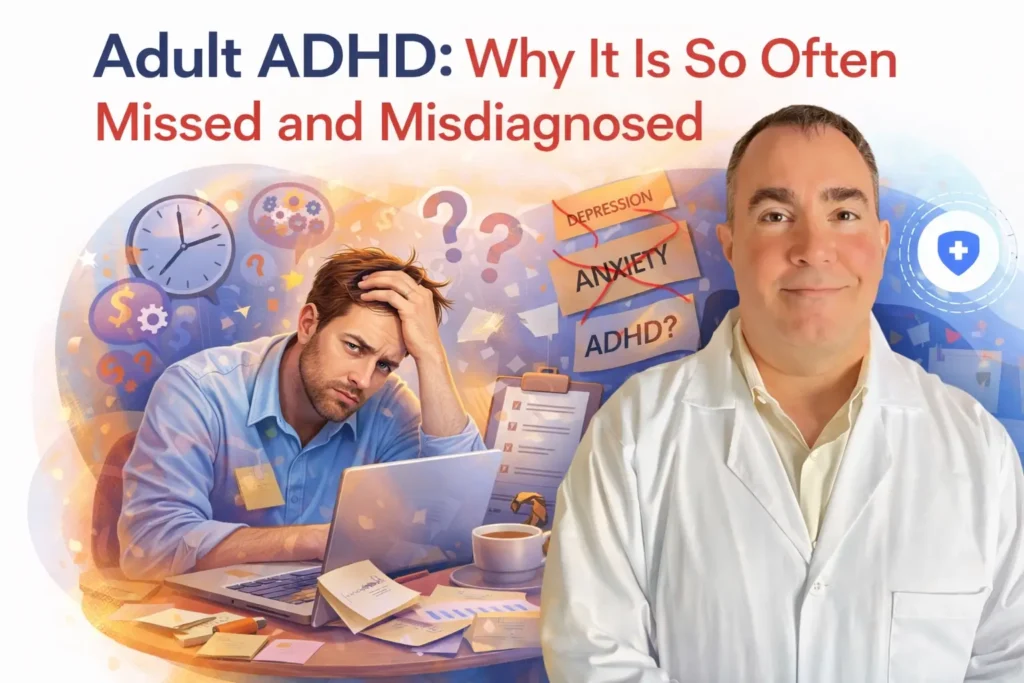
In my Trenton, NJ psychiatry practice, I regularly evaluate adults in their 30s, 40s, and 50s who are receiving an ADHD diagnosis for the first time. Some of them have spent decades being told they were lazy, undisciplined, or not living up to their potential. Others were treated for anxiety or depression for years, with limited success, because the underlying ADHD was never identified. Some simply assumed that the way they experienced the world was just ‘how they were.’
Adult ADHD is not rare. Studies consistently estimate that more than 60% of children with ADHD continue to experience clinically significant symptoms into adulthood. Yet recognition and diagnosis in adulthood remain far below what the prevalence data would suggest. Why?
Reason 1: The Stereotype of ADHD Doesn’t Match Adult Presentation
The cultural image of ADHD, a hyperactive boy who can’t sit still in class, does not describe most adults with the condition. Adult ADHD more commonly presents as an internal experience:
- A mind that races and jumps between thoughts, making sustained focus exhausting
- Chronic difficulty completing tasks that are boring or repetitive, even when consequences are significant
- Time blindness, a poor intuitive sense of how long things take or how much time has passed
- Emotional dysregulation, intense, rapid emotional responses that can look like mood instability
- Restlessness that is internal rather than physical, an inability to mentally settle
Adults who present with these symptoms are often diagnosed with anxiety, depression, bipolar disorder, or a personality disorder rather than ADHD, because the ADHD presentation is not what clinicians expect to see.
Reason 2: High Intelligence Can Mask ADHD for Decades
Many adults with ADHD were academically capable enough to compensate through school. They developed workarounds, studying intensively the night before an exam, relying on interest-based motivation, using structure imposed by external deadlines rather than internal organization. Their performance was adequate, so no one looked deeper.
The masking often breaks down in adulthood, when external structure is reduced, demands increase, and compensatory strategies can no longer keep up. A highly capable professional suddenly struggling to manage competing priorities, remember commitments, or complete long-term projects may be experiencing ADHD that was present but hidden for years.
In my clinical experience, the patients who most surprise themselves with an adult ADHD diagnosis are often those who were described as ‘smart but inconsistent’ or ‘capable of more’ throughout their education, people who worked twice as hard as their peers to produce equivalent results. |
Reason 3: The Inattentive Presentation Is Underrecognized
ADHD without significant hyperactivity, the Predominantly Inattentive presentation, is quieter, less disruptive, and far easier to miss. It is also more common in girls and women, contributing to a significant gender gap in diagnosis rates. A girl who sits quietly in class but struggles to absorb information, loses track of assignments, and feels perpetually overwhelmed is far less likely to receive evaluation than a boy who is disruptive.
These inattentive children often become adults who describe themselves as disorganized, forgetful, and chronically behind, but who have never been told there might be a neurobiological explanation.
Reason 4: Comorbid Conditions Obscure the Diagnosis
ADHD rarely travels alone. Anxiety, depression, and sleep disorders are extremely common in adults with undiagnosed ADHD, often as secondary consequences of years of struggling without support. When a patient presents with prominent anxiety, clinicians (understandably) focus on the anxiety. When depression dominates, the depression gets treated. The ADHD, which may be driving both, goes unaddressed.
Treating anxiety and depression without addressing underlying ADHD often produces partial improvement at best. The patient feels somewhat better but continues to struggle with the executive function difficulties that make daily life so hard. Only when the ADHD is identified and treated does the full picture improve.
What Getting Evaluated Actually Involves
A comprehensive adult ADHD evaluation is not a brief appointment or a questionnaire. In my practice, it involves a detailed clinical interview covering current symptoms, developmental history, school and work performance patterns, relationship history, family history, and any prior psychiatric diagnoses.
I pay particular attention to the longitudinal pattern: ADHD symptoms must have been present from childhood (even if not recognized), must occur across multiple settings, and must cause meaningful impairment. This distinguishes ADHD from conditions like anxiety or depression that can produce attention difficulties secondarily.
What Happens After Diagnosis
For many patients, receiving an accurate diagnosis in adulthood is both a relief and a grief, relief at finally understanding what has been happening, and grief for time and opportunities lost to an unrecognized condition. Both responses are valid, and I take time in our appointments to address them.
Treatment for adult ADHD, typically a combination of medication management and behavioral strategies, can be remarkably effective. It is not too late. The patients I see who receive treatment in their 40s and 50s often describe it as transformative: not because they become different people, but because they finally have access to the support that makes their actual capabilities visible.
If you recognize yourself in this description, a comprehensive evaluation is the right next step. Dr. David Bresch, MD provides adult ADHD evaluation and treatment in Trenton, NJ and throughout New Jersey via TelePsychiatry. Call (609) 588-0250. |