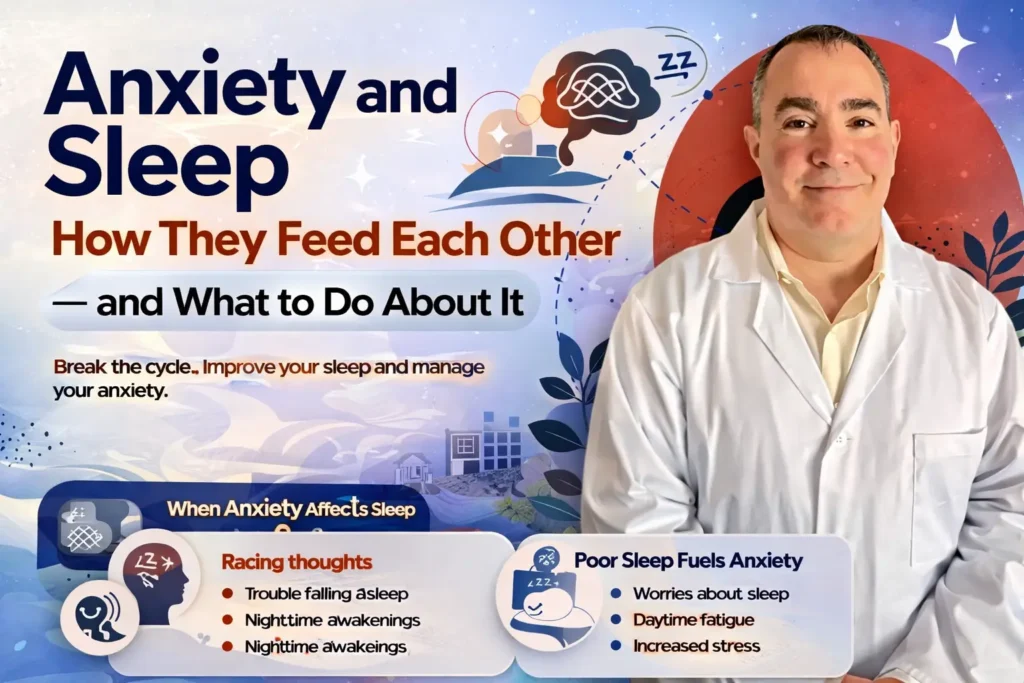
One of the most consistent patterns I see in my Trenton, NJ practice, and one that my dual training in psychiatry and sleep medicine puts me in a unique position to address, is the anxiety-sleep cycle. Anxious patients have disrupted sleep. Sleep-deprived patients have lower anxiety thresholds. Each condition worsens the other, and treating only one without addressing the other is one of the most common reasons patients plateau in treatment.
This post explains the relationship from a clinical standpoint and describes how I approach it in practice.
How Anxiety Disrupts Sleep
Anxiety activates the sympathetic nervous system, the body’s ‘threat response’ system. Cortisol and adrenaline rise, heart rate increases, muscles tighten, and the brain shifts into a hypervigilant, scanning mode. This is the opposite of the physiological state required for sleep onset. The parasympathetic nervous system, ‘rest and digest’, must predominate for the brain to downregulate from wakefulness into sleep.
For anxious patients, this activation does not simply switch off at bedtime. The brain, which has been running threat-detection algorithms all day, does not recognize the bedroom as a safe, low-arousal environment. Racing thoughts, ‘what if’ rumination, physical tension, and hyperarousal are the neurobiological result, not a character flaw or weakness.
The specific sleep disruption patterns I see in anxious patients include:
- Sleep onset insomnia: difficulty falling asleep due to racing thoughts and hyperarousal
- Sleep maintenance insomnia: waking in the early hours (typically 2-4 AM) and being unable to return to sleep
- Non-restorative sleep: sleeping a full night but waking feeling unrefreshed, often associated with increased light-stage sleep and reduced deep sleep
- Anticipatory wakefulness: waking before the alarm, often with immediate anxiety activation
How Poor Sleep Worsens Anxiety
Sleep deprivation has direct effects on the neurological systems that regulate anxiety. The amygdala, the brain’s threat-detection center, becomes significantly more reactive after even one night of poor sleep. Research from the University of California Berkeley demonstrated that sleep deprivation increased amygdala reactivity to emotional stimuli by approximately 60%, while simultaneously reducing the prefrontal cortex’s ability to modulate that reactivity. In plain terms: poor sleep makes the anxious brain more anxious.
Beyond acute effects, chronic sleep deprivation alters cortisol regulation, disrupts the balance of neurotransmitters including serotonin and GABA, and impairs the emotional processing that normally occurs during REM sleep. Patients who are chronically sleep-deprived are essentially running their anxiety management system on a depleted battery, every day.
The Clinical Catch-22
The anxiety-sleep cycle creates a genuine treatment challenge. Treating the anxiety reduces sleep disruption, but if the sleep problem is severe, it maintains anxiety even when psychological treatments are effective. Conversely, addressing sleep can dramatically reduce anxiety, but anxious patients are hard to treat for insomnia because they have conditioned hyperarousal in the bedroom environment.
This is where my dual training adds something concrete. I am evaluating both systems simultaneously rather than treating the anxiety and assuming the sleep will resolve, or vice versa.
How I Approach Anxiety-Related Insomnia in My Practice
Cognitive Behavioral Therapy for Insomnia (CBT-I)
CBT-I is the first-line treatment for chronic insomnia and is specifically effective for anxiety-related sleep disruption. It addresses the conditioned hyperarousal and dysfunctional sleep beliefs that perpetuate insomnia independently of the anxiety that may have started it. I discuss CBT-I with my patients and facilitate referral to a trained CBT-I provider when appropriate.
Medication Considerations
For the anxiety component, SSRIs and SNRIs, which are first-line for GAD and panic disorder, do affect sleep architecture and can initially worsen insomnia before improving it. I time and dose these medications with this in mind. For sleep, I am conservative with benzodiazepines and Z-drugs (zolpidem, eszopiclone) due to dependence risk, and more often turn to low-dose doxepin, mirtazapine, or trazodone as sleep-supportive agents with better long-term safety profiles.
Ruling Out Primary Sleep Disorders
I also screen for primary sleep disorders, particularly obstructive sleep apnea, which can present as insomnia and dramatically worsen anxiety and mood. Sleep apnea is significantly underdiagnosed in women and in patients with lower BMI, both of whom fall outside the ‘classic’ profile. An anxious patient who snores, wakes frequently, or has a bed partner who reports breathing pauses warrants at minimum a discussion about a sleep study.
A Note to Patients
If you are treating anxiety with a therapist or psychiatrist and your sleep has not been a focus of that treatment, I would encourage you to raise it directly. The sleep component is not secondary, it is often the mechanism keeping the anxiety entrenched. If you are in the Trenton-Hamilton area of Mercer County, NJ, or anywhere in New Jersey, I am available for TelePsychiatry appointments specifically for patients whose anxiety and sleep are interconnected. Call (609) 588-0250.