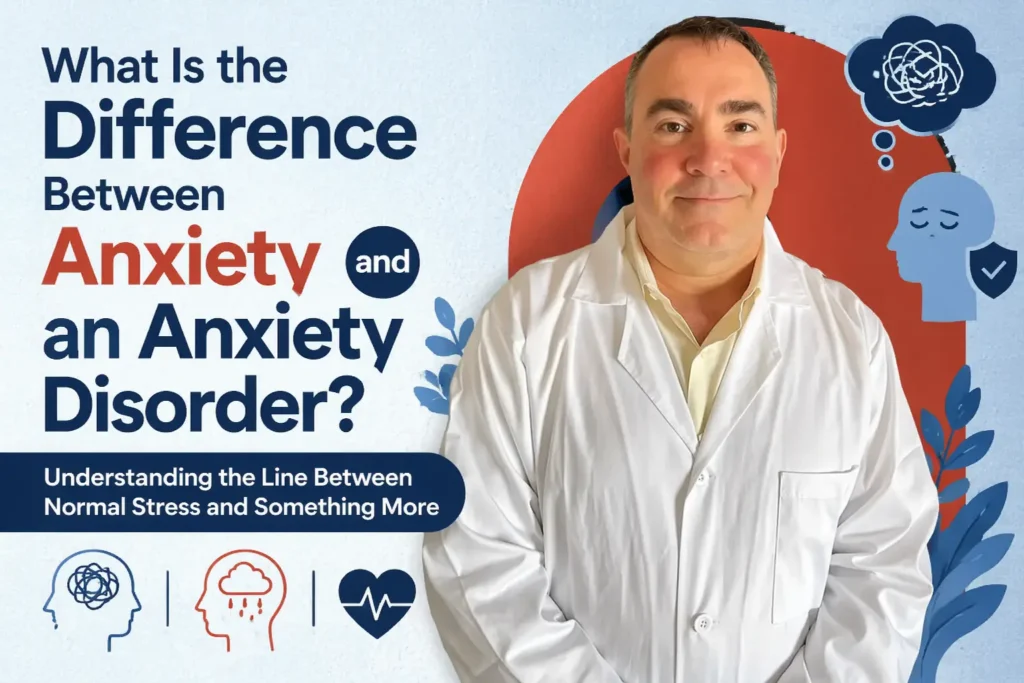
Anxiety is one of the most overused words in everyday conversation, and one of the most clinically precise terms in psychiatry. When a patient tells me they have ‘anxiety,’ I have learned to ask what they mean, because the answer ranges enormously: from a healthy nervous system response to a deadline, to a debilitating condition that has prevented someone from leaving their home for weeks.
Understanding the difference between normal anxiety and an anxiety disorder is not just academic. It determines whether watchful waiting is appropriate, whether therapy alone is sufficient, or whether medication has a meaningful role to play. Here is how I explain it to patients in my Trenton, NJ practice.
What Normal Anxiety Looks Like
Anxiety in its healthy form is your brain’s threat-detection system working correctly. Before a difficult conversation, a job interview, or a medical procedure, feeling nervous, alert, and slightly on edge is adaptive. It focuses attention and motivates action. It resolves when the stressor passes.
In clinical terms, this is acute stress response, time-limited, proportional to the situation, and not impairing your function. Almost everyone experiences this. It does not require treatment.
When Anxiety Becomes a Disorder
An anxiety disorder emerges when anxiety becomes disproportionate, persistent, and begins to interfere with functioning. The key clinical criteria are:
• Duration: symptoms present most days for at least six months (for GAD)
• Severity: anxiety is difficult or impossible to control even when you recognize it is excessive
• Impairment: affecting work, relationships, physical health, or daily activities
• Physical symptoms: sleep disruption, muscle tension, fatigue, concentration problems, irritability
In my practice, I see many patients who have lived with anxiety disorders for years, sometimes decades, before seeking help, because they assumed their experience was normal. ‘I have always been a worrier’ is something I hear frequently. But chronic, uncontrolled anxiety is not simply a personality trait. It has a neurobiological basis and it responds to treatment.
The Major Anxiety Disorders, How They Differ
Generalized Anxiety Disorder (GAD)
GAD involves excessive, difficult-to-control worry about multiple areas of life, work, health, family, finances, that persists for six months or more. Patients with GAD often describe their brain as ‘never turning off.’ Physical symptoms, particularly insomnia, muscle tension, and fatigue, are almost universal. GAD is the anxiety disorder I see most commonly in adult outpatient practice.
Panic Disorder
Panic disorder involves recurrent, unexpected panic attacks, sudden surges of intense fear accompanied by physical symptoms like racing heart, shortness of breath, chest tightness, and dizziness, followed by persistent worry about future attacks or behavioral changes to avoid them. Many patients with panic disorder initially present to emergency rooms or cardiologists before a psychiatric diagnosis is made.
Social Anxiety Disorder
Social anxiety goes well beyond shyness. It involves intense, persistent fear of social situations in which the person might be judged, embarrassed, or humiliated, and avoidance behavior that significantly limits life. It is one of the most underdiagnosed conditions I see, particularly in adults who have built careful lives around avoiding triggering situations.
A Clinical Note on ‘High-Functioning’ Anxiety
One pattern I want to name explicitly: high-functioning anxiety. These are patients, often high achievers, who experience significant internal anxiety but whose external performance appears intact or even exceptional. They are productive, organized, and responsible, but driven by fear of failure rather than genuine motivation. They rarely present for treatment until the system breaks down: a panic attack, burnout, or a physical health crisis. If you recognize yourself in this description, the fact that you are ‘still functioning’ does not mean treatment would not profoundly improve your quality of life.
When to Seek Evaluation
You do not have to be unable to function to deserve evaluation. I recommend seeing a psychiatrist when anxiety is present most days, when it is causing you distress even if you are managing it, or when you are making choices, avoiding situations, relationships, or opportunities, because of it. A single evaluation can clarify whether what you are experiencing meets diagnostic criteria and what, if anything, would help.
I provide psychiatric evaluations for anxiety disorders at my Trenton, NJ practice, with TelePsychiatry available throughout New Jersey. Call (609) 588-0250 to schedule.