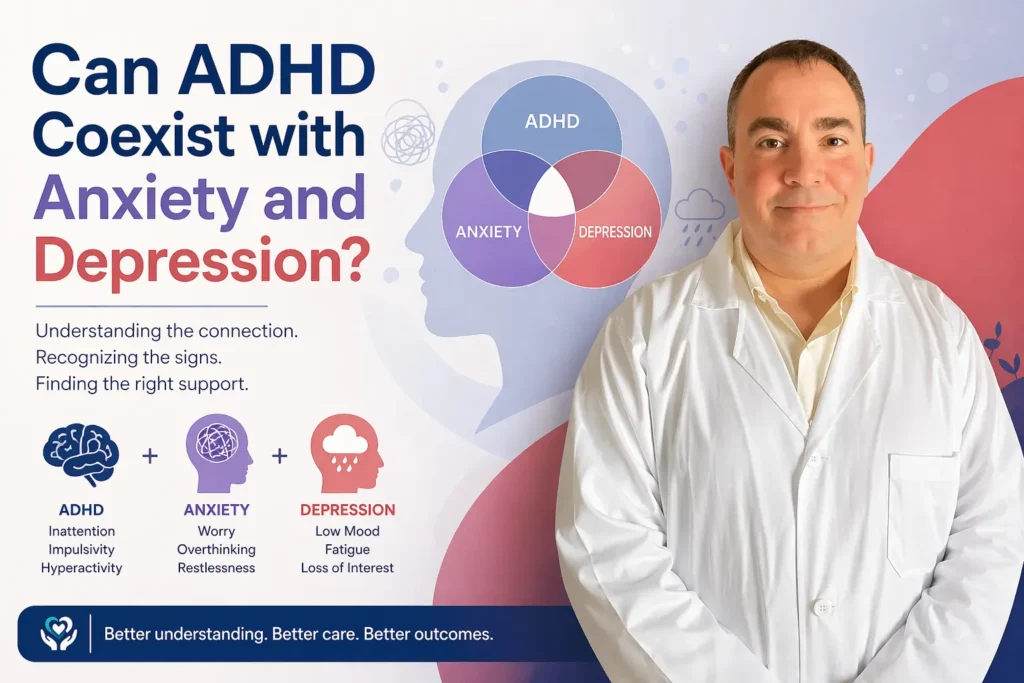
The short answer is yes, and it is far more common than most people realize. In my Trenton, NJ practice, I would estimate that the majority of adults I evaluate for ADHD have at least one comorbid condition, most frequently anxiety or depression. Understanding how these conditions interact is not just academically interesting, it is clinically essential, because treating only one while ignoring the others produces incomplete results.
Let me walk through what the research shows, what I see in clinical practice, and why this complexity is something to take seriously rather than a reason to give up on treatment.
How Common Is the Overlap?
Research consistently shows high rates of comorbidity in ADHD:
- Approximately 50% of adults with ADHD have a comorbid anxiety disorder
- Approximately 30–40% of adults with ADHD have a comorbid depressive disorder
- Many adults have all three conditions simultaneously
These numbers are not coincidences. They reflect real neurobiological and psychological relationships between these conditions.
Why ADHD and Anxiety Frequently Coexist
ADHD-driven anxiety (secondary anxiety)
One of the most common scenarios I see is anxiety that develops as a consequence of living with unmanaged ADHD. When someone chronically forgets commitments, misses deadlines, loses important items, and underperforms relative to their abilities, despite genuine effort, anxiety is a natural response. The nervous system is essentially on constant alert, waiting for the next failure or embarrassment.
This type of anxiety is driven by the ADHD. When the ADHD is treated effectively, the anxiety often diminishes significantly, sometimes without needing to be treated separately at all.
Independent anxiety disorders
Some patients with ADHD have a true anxiety disorder that exists independently of the ADHD, driven by its own neurobiological mechanisms and not simply a consequence of struggling. Generalized Anxiety Disorder and social anxiety are particularly common in this group. Here, both conditions require treatment in their own right.
The diagnostic challenge
Anxiety can also mimic or mask ADHD: a highly anxious person may be distracted, have trouble concentrating, and avoid tasks, all of which look like ADHD from the outside. Distinguishing ADHD from anxiety-driven attention difficulties is one of the most important parts of a thorough evaluation. My neuropsychiatric training is particularly relevant here.
Why ADHD and Depression Frequently Coexist
Depression in adults with ADHD can develop through several pathways:
- Years of underperformance and unmet potential erode self-esteem and produce genuine hopelessness
- The dysregulation of the dopamine system in ADHD overlaps with the dopamine-related dysfunction in depression
- Chronic exhaustion from compensating for ADHD , always working harder than others to achieve the same results, depletes emotional resources
- Social and relationship consequences of untreated ADHD (career setbacks, relationship failures) create real losses that depression follows
Like anxiety, ADHD-driven depression sometimes improves significantly when the ADHD is treated. But when depression is severe, with prominent low mood, hopelessness, or suicidal ideation, it must be treated directly, not assumed to resolve on its own.
The Treatment Challenge: What Helps and What Doesn’t
Treating ADHD with comorbid anxiety or depression requires careful medication selection:
- Stimulants for ADHD can worsen anxiety in some patients. When anxiety is prominent, I often consider non-stimulant options (atomoxetine, bupropion) that address both ADHD and mood/anxiety, or use lower stimulant doses alongside an SSRI for anxiety.
- Antidepressants (SSRIs) treat depression and anxiety effectively but do not meaningfully address ADHD. A patient with all three conditions typically needs a treatment plan that addresses each.
- Bupropion (Wellbutrin) is particularly useful when ADHD and depression coexist, as it has dopamine/norepinephrine effects relevant to both.
The sequencing and combination of treatments requires clinical judgment. I do not use a standard template, I evaluate the relative severity and urgency of each condition and prioritize accordingly. In some patients, treating the depression first allows the ADHD evaluation to be cleaner. In others, treating the ADHD reveals how much of the anxiety and depression was secondary and resolves on its own.
The Importance of a Complete Evaluation
This complexity is exactly why I spend significant time in initial evaluations. A 15-minute appointment cannot capture the nuances of a patient with ADHD, anxiety, and depression, three conditions that overlap, interact, and influence each other. Getting the diagnosis right across all three conditions is the foundation of effective treatment.
Many patients who come to me have been treated for one condition for years, with partial results, precisely because the other conditions were not identified. When we address the full picture, outcomes are consistently better.
If you’re struggling with what may be ADHD, anxiety, depression, or all three, a comprehensive evaluation is the most important first step. Dr. David Bresch, MD provides thorough neuropsychiatric evaluations in Trenton, NJ and via TelePsychiatry throughout New Jersey. Call (609) 588-0250. |