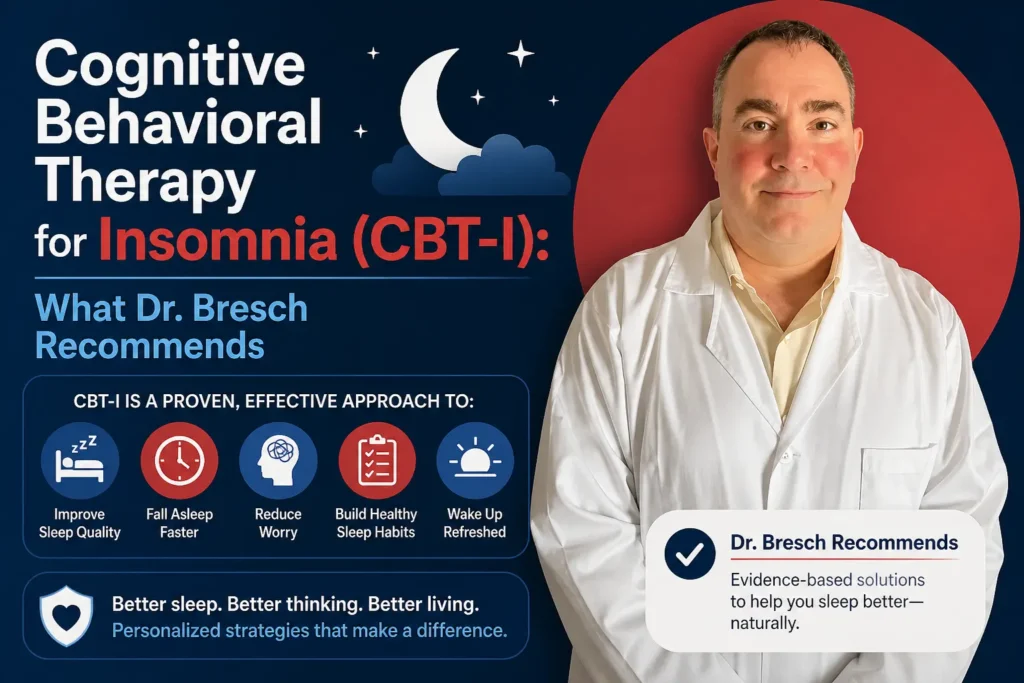
If you’ve struggled with insomnia, you’ve likely tried quick fixes, melatonin, sleep apps, or even prescription medications. While these may offer temporary relief, they often don’t address the underlying issue.
That’s where Cognitive Behavioral Therapy for Insomnia (CBT-I) comes in.
CBT-I is widely recognized as the gold standard, first-line treatment for chronic insomnia. Unlike medication, it targets the root causes of sleep problems, helping you build sustainable, long-term sleep habits.
At David Bresch MD, CBT-I is a core part of treatment for patients experiencing insomnia linked to anxiety, depression, or behavioral sleep patterns.
What Is CBT-I?
CBT-I is a structured, evidence-based therapy designed to improve sleep by changing:
- Thoughts about sleep
- Behaviors that interfere with sleep
- Emotional responses related to sleep
It is typically delivered over several sessions and tailored to each individual’s sleep patterns and challenges.
Why CBT-I Works When Other Treatments Fail
Many sleep problems persist because they are learned behaviors and conditioned responses.
For example:
- You associate your bed with stress
- You check the clock repeatedly
- You worry about not sleeping
These patterns reinforce insomnia over time.
CBT-I breaks this cycle by retraining your brain and body to sleep naturally again.
The Core Components of CBT-I
CBT-I is not just one technique, it’s a combination of strategies that work together.
1. Sleep Restriction Therapy
This may sound counterintuitive, but it’s one of the most powerful components.
How It Works:
- Limits the amount of time you spend in bed
- Matches your time in bed to actual sleep time
- Gradually increases sleep duration as efficiency improves
Why It’s Effective:
It builds sleep pressure, helping you fall asleep faster and stay asleep longer.
2. Stimulus Control Therapy
Over time, insomnia can “retrain” your brain to associate your bed with wakefulness.
Rules include:
- Go to bed only when sleepy
- Use the bed only for sleep (and intimacy)
- Get out of bed if you can’t sleep
- Wake up at the same time every day
Goal:
Rebuild the connection between bed = sleep, not stress.
3. Cognitive Restructuring
This addresses the negative thoughts that fuel insomnia.
Common Thoughts:
- “I’ll never fall asleep”
- “I’ll be exhausted tomorrow”
- “Something is wrong with me”
CBT-I Approach:
- Identify these thoughts
- Challenge them
- Replace them with realistic, balanced thinking
4. Sleep Hygiene Education
While often overemphasized alone, sleep hygiene plays a supportive role.
Key habits include:
- Limiting caffeine and alcohol
- Reducing screen time before bed
- Creating a consistent sleep schedule
- Maintaining a comfortable sleep environment
5. Relaxation Techniques
These help reduce physical and mental tension at night.
Techniques may include:
- Deep breathing
- Progressive muscle relaxation
- Guided imagery
- Mindfulness exercises
How CBT-I Differs from Sleep Medication
Short-Term vs Long-Term
Feature | Sleep Medication | CBT-I |
Relief | Immediate | Gradual |
Duration | Short-term | Long-term |
Dependency risk | Yes | No |
Addresses root cause | No | Yes |
Key Insight:
Medication may help you sleep, but CBT-I helps you learn how to sleep again.
Who Is CBT-I Best For?
CBT-I is effective for a wide range of individuals, including those with:
- Chronic insomnia
- Anxiety-related sleep problems
- Depression-related sleep disruption
- Stress-induced insomnia
- Difficulty maintaining sleep
It is especially beneficial for those who want to avoid long-term medication use.
What to Expect During CBT-I Treatment
CBT-I is typically delivered over 4–8 sessions, either in-person or via telehealth.
Initial Evaluation
At David Bresch MD, treatment begins with a comprehensive assessment of:
- Sleep patterns
- Daily routines
- Mental health factors
- Lifestyle habits
Sleep Diary Tracking
Patients often track:
- Bedtime and wake time
- Sleep duration
- Night awakenings
- Sleep quality
This data helps tailor the treatment plan.
Gradual Progress
Improvements typically occur in stages:
- Falling asleep faster
- Fewer awakenings
- More restful sleep
- Improved daytime energy
Addressing Common Concerns About CBT-I
“It sounds difficult.”
Some components, like sleep restriction, can feel challenging at first. However, they are temporary and highly effective when guided properly.
“Will it take too long?”
While CBT-I requires effort, it provides lasting results, unlike temporary fixes.
“What if my insomnia is caused by anxiety or depression?”
CBT-I works even better when combined with treatment for underlying mental health conditions.
At David Bresch MD, both are addressed together.
The Science Behind CBT-I
Research consistently shows that CBT-I:
- Improves sleep latency (time to fall asleep)
- Reduces nighttime awakenings
- Enhances sleep efficiency
- Improves overall sleep quality
It is recommended by major medical organizations as the first-line treatment for insomnia.
Long-Term Benefits of CBT-I
Unlike medication, the benefits of CBT-I continue long after treatment ends.
Patients often report:
- Better sleep consistency
- Reduced anxiety around sleep
- Improved mood
- Increased energy and focus
- Greater confidence in their ability to sleep
CBT-I and Mental Health Integration
Sleep and mental health are deeply connected.
CBT-I can also:
- Reduce anxiety symptoms
- Improve depression outcomes
- Enhance emotional regulation
This makes it a powerful tool in comprehensive psychiatric care.
When to Consider CBT-I
You may benefit from CBT-I if:
- You’ve had insomnia for more than a few weeks
- Sleep medications aren’t working, or you want to avoid them
- You feel anxious about sleep
- Your sleep schedule feels inconsistent
- You wake up tired despite time in bed
Why Work with a Psychiatrist for CBT-I?
While CBT-I can be delivered by different providers, a psychiatrist offers added advantages:
- Ability to diagnose underlying mental health conditions
- Medication management if needed
- Integrated treatment approach
- Personalized care
At David Bresch MD, CBT-I is part of a comprehensive plan tailored to each patient.
Final Thoughts
If you’ve been relying on temporary fixes for insomnia, it may be time for a different approach.
CBT-I doesn’t just help you sleep, it helps you rebuild your relationship with sleep.
With the right guidance, lasting improvement is absolutely possible.
Take the First Step
Struggling with insomnia?
Schedule a consultation with David Bresch MD and explore whether CBT-I is right for you.