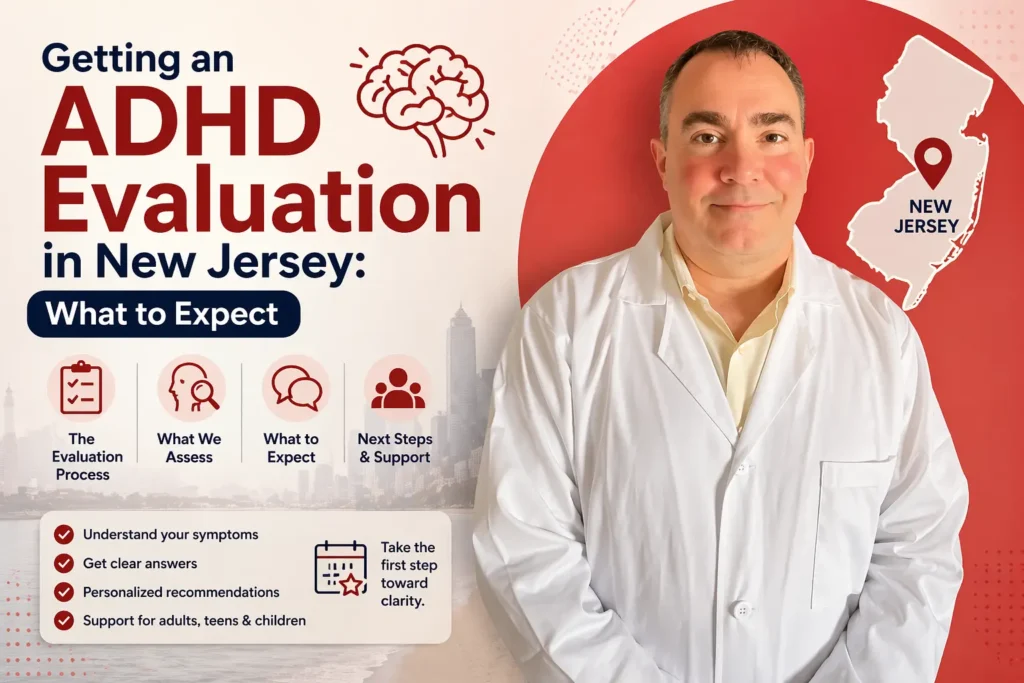
Deciding to seek an ADHD evaluation as an adult can feel like a significant step, and many people put it off because they’re unsure what the process actually involves, how long it takes, or what it means if they do receive a diagnosis. In my Trenton, NJ practice, I find that patients who understand what to expect before they come in feel more prepared and get more out of the evaluation.
This article walks through exactly what a comprehensive ADHD evaluation looks like at my practice, and what happens afterward.
Step 1: The Clinical Interview
The foundation of any accurate ADHD evaluation is a comprehensive clinical interview. This is not a brief checklist. I spend extended time with patients, exploring:
- Current symptoms: What specific difficulties are you experiencing now? How do they affect work, relationships, home life, and daily tasks?
- Developmental history: When did these difficulties begin? What were your school years like? Were you described as inattentive, hyperactive, or disruptive? Did you struggle more than peers with organization or follow-through?
- Family history: ADHD is highly heritable. A family history of ADHD in a parent or sibling increases the probability of the diagnosis.
- Comorbid conditions: Are anxiety, depression, or sleep disorders present? These are common alongside ADHD and must be evaluated, as they affect both diagnosis and treatment planning.
- Medical history: Thyroid disorders, anemia, sleep apnea, and other medical conditions can produce attention difficulties that are not ADHD. A thorough evaluation rules these out.
- Prior treatment: Have you been diagnosed with or treated for any psychiatric condition before? What helped and what didn’t?
A key diagnostic requirement for ADHD: symptoms must have been present in childhood (before age 12), must occur in more than one setting (not just at work or just at home), and must cause meaningful impairment. If these criteria are not clearly met, I will take additional time to gather more information before making a diagnosis. |
Step 2: Rating Scales and Questionnaires
I supplement the clinical interview with standardized rating scales, validated questionnaires that help quantify the severity of symptoms across different domains. Common tools include the Adult ADHD Self-Report Scale (ASRS) and Conners’ scales. For children, teacher and parent rating forms provide important cross-setting information that the child cannot self-report.
Rating scales are a useful tool, but they are not diagnostic on their own. A patient who scores highly on an ADHD questionnaire does not automatically have ADHD, anxiety, depression, and sleep disorders can produce similar scores. The rating scales inform the clinical picture; they do not replace clinical judgment.
Step 3: Neuropsychological Testing (When Indicated)
In some cases, particularly when the diagnosis is uncertain, when significant cognitive difficulties are present, or when there is a need to clarify the distinction between ADHD and a learning disability, I may recommend formal neuropsychological testing. This involves a battery of standardized cognitive assessments conducted by a neuropsychologist.
Not every ADHD evaluation requires neuropsychological testing. For most adults with a clear clinical presentation, a comprehensive interview and rating scales are sufficient. When testing is indicated, I provide a referral and incorporate the results into the overall evaluation.
Step 4: Arriving at a Diagnosis
At the conclusion of the evaluation, I share my diagnostic impressions with you directly and explain my reasoning. ADHD diagnosis requires meeting specific DSM-5 criteria, and I explain clearly whether those criteria are met and, if so, which presentation (inattentive, hyperactive-impulsive, or combined) best describes your experience.
If ADHD is not the primary diagnosis, I explain what I believe is driving the symptoms and what evaluation or treatment I recommend instead. An accurate diagnosis matters more than a particular diagnosis.
Step 5: Treatment Planning
If an ADHD diagnosis is established, the next conversation is about treatment options. I explain the full range, stimulant medications, non-stimulant medications, and behavioral approaches, and work with you to develop a plan based on your history, preferences, other medical conditions, and comorbid psychiatric conditions.
For medication, I typically begin at a conservative dose and follow up within two to four weeks to assess response and make any necessary adjustments.
TelePsychiatry for ADHD in New Jersey
ADHD evaluations and ongoing medication management can be conducted entirely via TelePsychiatry for New Jersey residents. This is particularly useful for patients who have difficulty with in-person appointments, have scheduling constraints, or live at a distance from Trenton. The quality of a TelePsychiatry evaluation for ADHD is equivalent to in-person care for the vast majority of patients.
Practical Information
- Location: 2000 Hamilton Ave, Trenton, NJ 08619
- Phone: (609) 588-0250
- Insurance: Medicare and most commercial insurance accepted
- TelePsychiatry: Available for NJ residents
- Hours: Monday, Tuesday, and Thursday 2 PM – 6 PM (call to confirm current availability)
Ready to schedule an ADHD evaluation? Dr. David Bresch, MD accepts new patients in Trenton, NJ and throughout New Jersey via TelePsychiatry. Call (609) 588-0250 to arrange your appointment. |