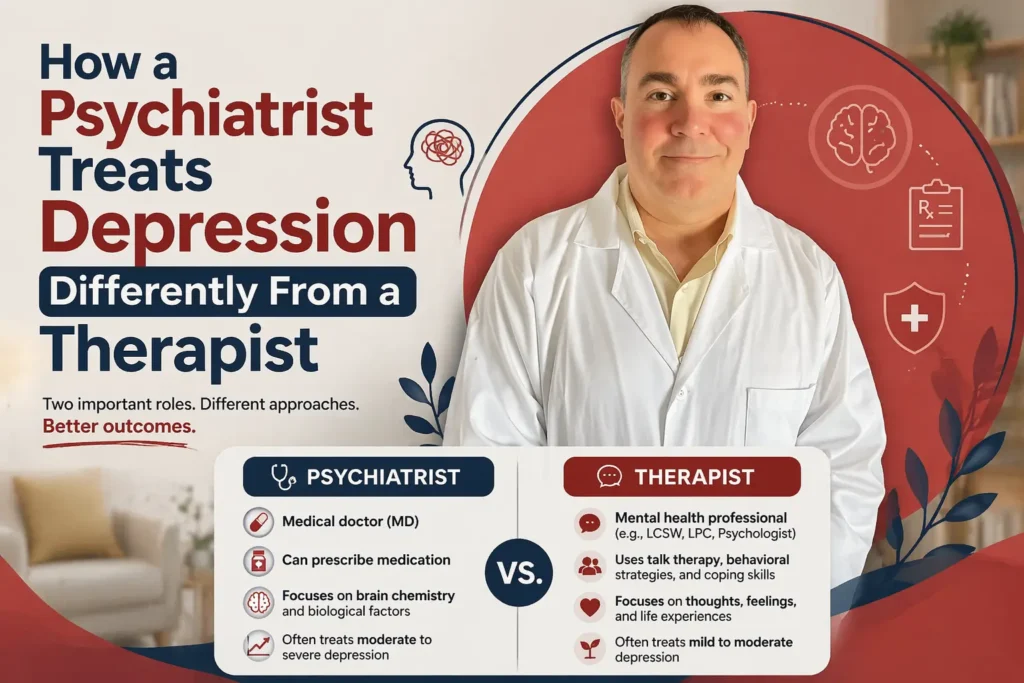
One of the most common questions patients ask me, and one of the most important, is: ‘Do I need a psychiatrist, or would a therapist be enough?’ The honest answer depends on the severity of your depression, whether you have had prior treatment, and several clinical factors that I assess during an evaluation. But I can explain the structural difference in a way that helps you make an informed decision.
What a Therapist Does for Depression
Therapists, psychologists, licensed clinical social workers (LCSWs), licensed professional counselors (LPCs), provide talk therapy. The most evidence-based therapy for depression is Cognitive Behavioral Therapy (CBT), which helps patients identify and change thought patterns and behaviors that perpetuate depressive episodes. Other modalities include Interpersonal Therapy (IPT), which focuses on relationship patterns, and Dialectical Behavior Therapy (DBT) for patients with emotional dysregulation.
Therapists cannot prescribe medication in New Jersey. Their work is done entirely through the therapeutic relationship, and it is powerful, clinical trials show that CBT for depression produces outcomes comparable to antidepressants for mild to moderate depression.
What a Psychiatrist Does for Depression
A psychiatrist is a medical doctor with specialized training in diagnosing and treating psychiatric conditions, including with medications. When I evaluate a patient for depression, I am doing several things simultaneously:
- Ruling out medical causes: thyroid disease, anemia, vitamin D deficiency, and other conditions mimic depression and must be excluded
- Diagnosing the specific type of depression: major depressive disorder, persistent depressive disorder, bipolar depression, and seasonal affective disorder each have different treatment implications
- Assessing severity: mild, moderate, and severe depression have different treatment evidence bases
- Identifying comorbidities: anxiety disorders, ADHD, substance use, and sleep disorders frequently co-occur with depression and must be treated simultaneously
- Prescribing and managing antidepressants: choosing the right medication, starting at the right dose, titrating appropriately, managing side effects, and knowing when to switch
My neuropsychiatry background adds another layer: I am evaluating whether neurological factors, including sleep architecture disruption, which I can assess given my sleep medicine training, are contributing to the depressive presentation. This matters more than it might seem, because sleep disorders and depression have a bidirectional relationship that, if unaddressed, causes both to be treatment-resistant.
When You Need a Psychiatrist, Not Just a Therapist
I generally recommend a psychiatric evaluation, rather than therapy alone — when:
- Depression is moderate to severe (significantly affecting work, relationships, sleep, or appetite)
- Therapy alone has not produced meaningful improvement after 8-12 sessions
- There are symptoms suggesting a different diagnosis, like bipolar disorder, which requires mood stabilizers, not just antidepressants
- There is significant sleep disruption, because untreated sleep problems dramatically reduce antidepressant response
- The patient has significant anxiety alongside depression, which affects medication selection
- There is any question of suicidal ideation or self-harm
- The patient has a history of antidepressant trials that have not worked, this requires a medication strategy, not just a first prescription
The Best Outcome: Psychiatrist and Therapist Working Together
In my practice, I frequently collaborate with therapists who are managing the therapy component of a patient’s care while I manage medications. This is the gold standard for moderate to severe depression, and the research supports it. Medication reduces symptom severity enough that patients can engage meaningfully in therapy. Therapy builds skills that reduce relapse risk when medication is eventually discontinued.
I always ask patients whether they are working with a therapist, and if not, whether they are interested in a referral. I see my role as a precise, targeted medical intervention, and therapy as the broader framework that helps patients build durable mental health.
A Practical Note for Trenton-Area Patients
Access to psychiatry in Mercer County, NJ is limited, many psychiatrists have long waitlists or do not accept Medicare. My practice accepts Medicare and commercial insurance, and TelePsychiatry is available for patients who cannot make my clinic hours (Monday, Tuesday, Thursday 2PM-6PM). If you have been waiting months for a psychiatric evaluation, call (609) 588-0250 to see whether I can help.