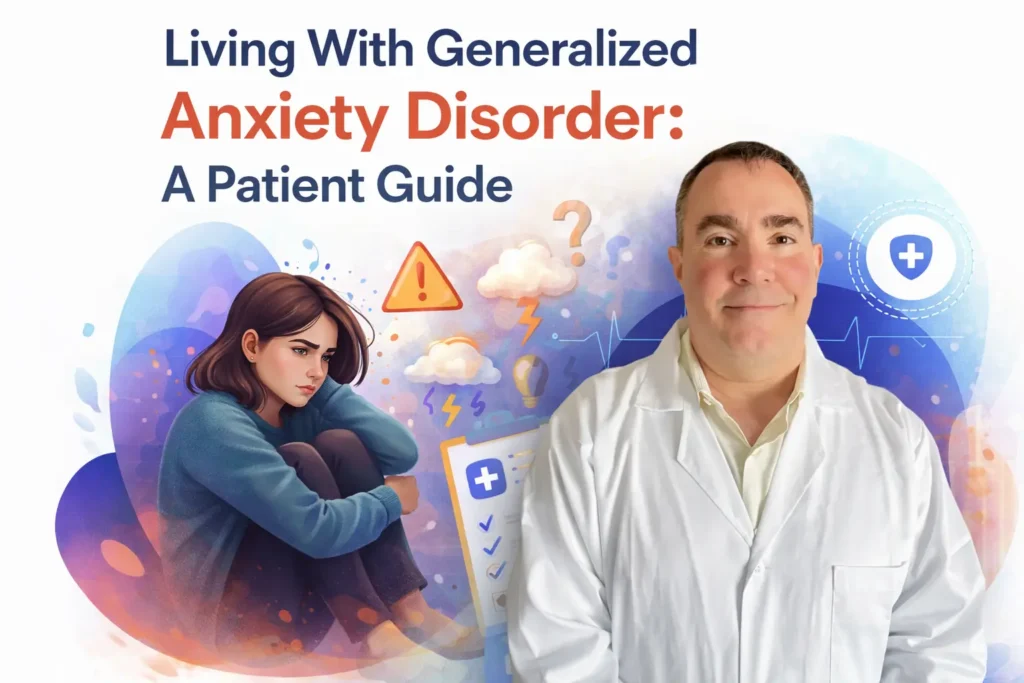
Generalized Anxiety Disorder is, in my experience, one of the conditions most commonly lived with, and least commonly treated, among adults in my Trenton, NJ patient population. People with GAD often describe themselves as ‘worriers by nature’ or say they have ‘always been anxious.’ They have typically adapted their lives around the anxiety in ways that feel normal until they compare notes with someone who does not share the condition.
This guide is written for patients who suspect they may have GAD, for those recently diagnosed, and for family members trying to understand what their loved one is experiencing.
What Generalized Anxiety Disorder Actually Is
GAD is defined by excessive, difficult-to-control worry occurring more days than not for at least six months, across multiple domains of life. The worry in GAD is not tied to a single topic, it moves. Patients worry about health, then finances, then their children’s safety, then whether they said something wrong in a conversation three days ago. The content shifts but the worry engine keeps running.
The diagnostic criteria also include at least three of the following physical and cognitive symptoms:
- Restlessness or feeling keyed up or on edge
- Being easily fatigued
- Difficulty concentrating or mind going blank
- Irritability
- Muscle tension
- Sleep disturbance, difficulty falling or staying asleep, or restless, unsatisfying sleep
What strikes me clinically is how physical GAD is. Many patients come to me having seen cardiologists for chest tightness, gastroenterologists for IBS symptoms, or rheumatologists for muscle pain, all of which can be anxiety-mediated. The brain-body connection in anxiety is not metaphorical. Chronic anxiety activates the HPA (hypothalamic-pituitary-adrenal) axis continuously, producing sustained cortisol elevation that has measurable effects on the gastrointestinal system, cardiovascular system, immune function, and musculoskeletal tension.
The GAD Brain: Why You Cannot ‘Just Stop Worrying’
This is the question GAD patients most often get from people who do not have the condition: ‘Why can’t you just stop worrying?’ The answer is neurobiological. GAD involves dysregulation of the amygdala-prefrontal cortex circuit, the system that normally allows the rational brain to downregulate threat signals from the emotional brain. In GAD, this regulatory system is overloaded or underperforming, meaning that worry thoughts feel urgent and real regardless of whether the rational mind recognizes them as disproportionate.
Many GAD patients are aware, intellectually, that their worry is excessive. They can articulate ‘I know this is irrational.’ That awareness does not stop the worry. This is not weakness, it is the nature of the disorder, and it is one of the reasons behavioral strategies (like CBT) that work on the cognitive-behavioral level, and medications that address the underlying neurobiology, are both needed for significant GAD.
How GAD Affects Daily Life
Work and Performance
GAD can produce what looks paradoxically like high performance, the anxious person who over-prepares, works excessive hours, and never misses a deadline. But this is often anxiety-driven rather than ambition-driven, and it is unsustainable. Burnout, perfectionism-related paralysis, and difficulty delegating are common GAD presentations in the workplace.
Relationships
GAD affects relationships through reassurance-seeking behavior (repeatedly asking for reassurance about the same worry), hypervigilance to perceived conflict, difficulty being present, and irritability from chronic fatigue and overstimulation. Partners and family members often feel the pressure of the anxiety without understanding its source.
Physical Health
Chronic anxiety has established negative effects on cardiovascular health, immune function, gastrointestinal health, and sleep quality. Managing GAD is not just about quality of life, it is about physical health outcomes over time.
Treatment: What Actually Works
Psychotherapy
Cognitive Behavioral Therapy (CBT) is the first-line psychotherapeutic treatment for GAD and has the strongest evidence base. It targets the specific cognitive patterns, overestimation of threat, intolerance of uncertainty, worry as a coping strategy, that maintain the disorder. CBT for GAD typically involves 12-16 structured sessions with a trained therapist. I refer to licensed therapists experienced with GAD for this component of care.
Medication
First-line medications for GAD are SSRIs (sertraline, escitalopram, paroxetine) and SNRIs (venlafaxine, duloxetine). These medications reduce baseline anxiety over weeks of use, they are not fast-acting. Buspirone is an alternative with a different mechanism that can be effective for some patients. I do not use benzodiazepines as a first-line treatment for GAD given dependence risk, though there are specific clinical scenarios where short-term use is appropriate.
Sleep
Because GAD almost universally disrupts sleep, and because sleep deprivation worsens anxiety, I address sleep directly in GAD treatment. This may involve sleep hygiene guidance, referral for CBT-I, or a low-dose sleep-supportive medication. My sleep medicine background is directly relevant here, I can evaluate whether the sleep problem is primarily anxiety-driven or whether a primary sleep disorder is contributing.
A Realistic Word on Recovery
GAD is a chronic condition for many patients, which does not mean it cannot be managed effectively. Most patients with GAD, with appropriate treatment, achieve meaningful symptom reduction and significantly improved quality of life. Some patients achieve full remission. What matters is having a treatment plan built around your specific presentation, not a generic protocol.
If you are in the Trenton, Hamilton, or Mercer County, NJ area and have been living with anxiety that feels constant, out of proportion, and exhausting, I would encourage you to schedule a psychiatric evaluation. You do not need to continue managing it alone. Call (609) 588-0250 or request a TelePsychiatry appointment throughout New Jersey.