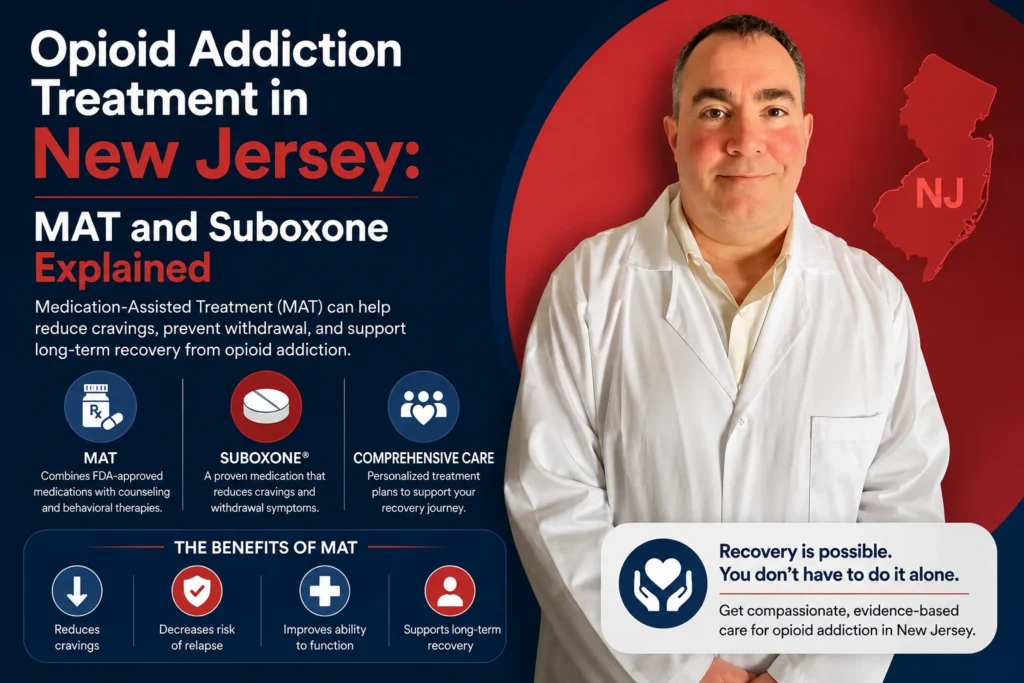
New Jersey has been one of the states most severely impacted by the opioid epidemic. In Mercer County, which encompasses Trenton and Hamilton, where my practice is located, opioid overdose deaths have reached among the highest rates in the state. Medication-Assisted Treatment (MAT) with buprenorphine (Suboxone) is the most effective intervention available for opioid use disorder, and it is strikingly underutilized relative to the scale of the problem.
Part of that underutilization is due to persistent stigma and misconception, including from within the medical community, about what MAT is and what it accomplishes. In this article, I want to explain directly what the treatment involves, what the evidence shows, and what patients considering it need to know.
What Medication-Assisted Treatment (MAT) Is
Medication-Assisted Treatment refers to the use of FDA-approved medications, in combination with counseling and behavioral therapies, to treat substance use disorders. For opioid use disorder (OUD), the three FDA-approved medications are:
- Buprenorphine (most commonly Suboxone, which combines buprenorphine with naloxone): The most widely used MAT medication in outpatient settings. Available as a sublingual film or tablet. Can be prescribed by qualified physicians in office-based settings.
- Methadone: A full opioid agonist dispensed daily at federally licensed opioid treatment programs (OTPs). Highly effective but requires daily attendance at a clinic, which limits accessibility for some patients.
- Naltrexone (Vivitrol): An opioid antagonist that blocks opioid effects. Available as an extended-release monthly injection. No physical dependence develops, but requires complete opioid detoxification before initiation and has lower treatment retention than buprenorphine in most studies.
At my practice in Trenton, I prescribe buprenorphine (Suboxone) for eligible patients with opioid use disorder and evaluate appropriate patients for naltrexone (Vivitrol). I refer patients who may benefit from methadone to licensed OTPs in the Mercer County area.
How Buprenorphine (Suboxone) Works
Buprenorphine is a partial opioid agonist, it activates opioid receptors, but with a ceiling effect that limits the degree of opioid effects it produces. At therapeutic doses, it:
- Eliminates opioid withdrawal symptoms: The physical and psychological withdrawal from opioids, severe muscle aches, nausea, vomiting, diarrhea, anxiety, insomnia, is blocked by buprenorphine, removing one of the primary drivers of relapse in the first weeks of recovery.
- Substantially reduces opioid craving: Buprenorphine stabilizes the brain’s opioid system, reducing the intense craving that drives compulsive opioid seeking.
- Blocks euphoric effects of other opioids: Due to its high receptor affinity, buprenorphine occupies opioid receptors in a way that blunts the effect of additionally used opioids, reducing the reward value of relapse.
- Reduces overdose risk: The ceiling effect on respiratory depression makes buprenorphine significantly safer than full opioid agonists in cases of accidental excess dosing.
The naloxone component of Suboxone is added specifically to deter injection misuse: if injected rather than dissolved under the tongue, the naloxone component precipitates immediate withdrawal. When taken as prescribed sublingually, the naloxone is minimally absorbed and does not interfere with the buprenorphine’s therapeutic effect.
Buprenorphine (Suboxone) is not simply replacing one opioid addiction with another. This is the most common misconception about MAT and the one that most frequently prevents patients from accessing treatment that could save their lives. Physical dependence, the phenomenon by which the body adapts to a substance and experiences withdrawal upon its removal, occurs with many medications (blood pressure medications, antidepressants, steroids) without constituting addiction. Addiction involves compulsive use despite harm, loss of control, and inability to prioritize other activities. Buprenorphine, when taken as prescribed, does not produce these features. |
The Evidence for MAT in Opioid Use Disorder
The evidence base for MAT with buprenorphine is among the strongest in addiction medicine:
- Treatment retention: Patients in buprenorphine treatment are significantly more likely to remain in treatment than those who attempt abstinence without medication, a critical outcome because the period off treatment is the period of greatest overdose risk.
- Overdose mortality: Multiple studies demonstrate 50 to 70% reductions in overdose mortality among patients maintained on buprenorphine compared to untreated opioid use disorder.
- Illicit opioid use: Buprenorphine treatment significantly reduces illicit opioid use, as documented by urine drug screening in clinical studies.
- Social functioning: Employment, family relationships, and legal outcomes all improve with sustained MAT engagement.
New Jersey law requires that buprenorphine treatment be accompanied by a counseling component. At my practice, I take this seriously as a clinical standard: medication stabilizes the neurobiological dimension of opioid use disorder, while counseling addresses the behavioral, psychological, and social dimensions that medication alone cannot reach. |
Who Qualifies for Suboxone Treatment
Buprenorphine treatment is appropriate for patients who meet DSM-5 criteria for opioid use disorder, a diagnosis that reflects the degree to which opioid use has become compulsive, uncontrollable, and harmful. Qualification is based on a comprehensive clinical evaluation, not on the specific opioid used (prescription versus heroin) or the route of administration.
There are medical contraindications: significant liver disease may require dose adjustment or alternative treatment. Respiratory depression risk from concurrent benzodiazepine or alcohol use requires careful management. Pregnancy requires specific MAT protocols, I refer pregnant patients with OUD to appropriate specialized care.
What Initiating Treatment Looks Like
Buprenorphine induction, the process of starting the medication, requires that the patient be in at least mild opioid withdrawal before the first dose. Taking buprenorphine before withdrawal begins can precipitate acute, severe withdrawal through a process called precipitated withdrawal. I provide detailed instructions about timing the first dose and monitor closely in the early induction period.
After a stable dose is established, typically within one to two weeks, follow-up appointments occur at intervals that reflect clinical stability: monthly for stable patients, more frequently during dose adjustment or periods of increased risk. Urine drug screening is conducted regularly as part of treatment monitoring.
Length of Treatment
The evidence strongly supports long-term maintenance over time-limited treatment followed by medication discontinuation. Relapse rates after buprenorphine discontinuation are high, and each relapse carries overdose risk. The decision to taper and discontinue buprenorphine is made collaboratively and based on sustained stability, strong psychosocial recovery, and the patient’s values and goals, not based on an arbitrary time limit.
To discuss buprenorphine (Suboxone) treatment for opioid use disorder with Dr. David Bresch, MD in Trenton, NJ, call (609) 588-0250. Medicare and commercial insurance accepted. Located at 2000 Hamilton Ave, Trenton, NJ 08619. |