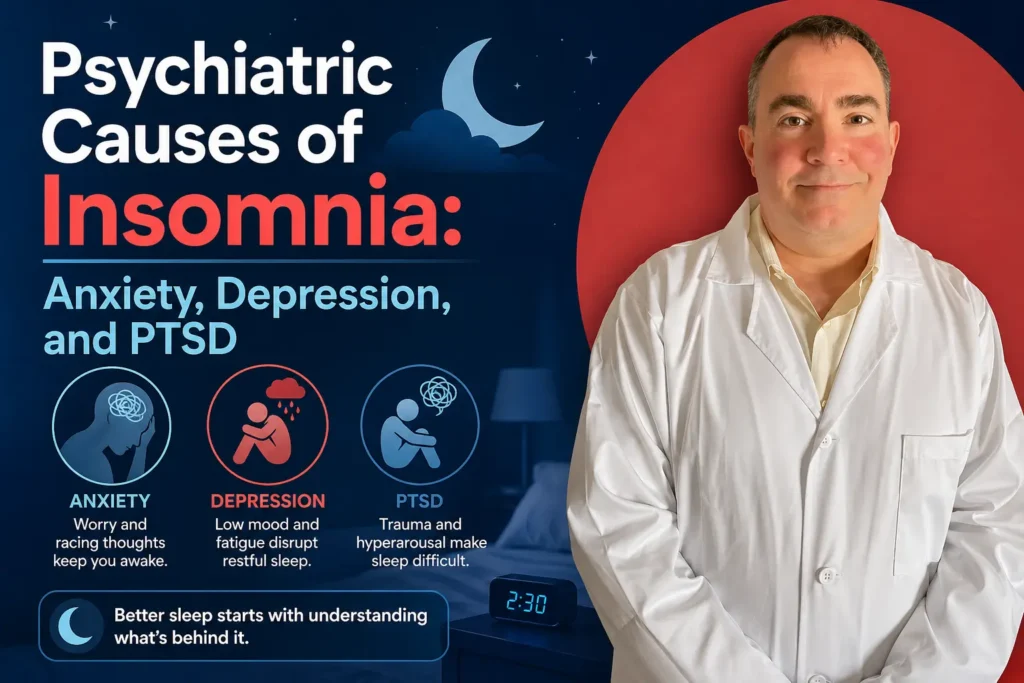
Sleep is one of the most fundamental biological processes, yet for many individuals, it becomes a nightly struggle. If you’ve ever found yourself lying awake with racing thoughts, waking up too early, or feeling exhausted despite spending hours in bed, you may be dealing with insomnia.
But here’s the key insight many people miss:
Insomnia is often not the primary problem: it’s a symptom.
In many cases, the real cause lies deeper within the brain and emotional system. Conditions such as anxiety, depression, and post-traumatic stress disorder (PTSD) are among the most common psychiatric drivers of chronic insomnia.
At David Bresch MD, insomnia is treated by addressing both the sleep disturbance and the underlying mental health condition, leading to more effective and lasting results.
Understanding the Mind–Sleep Connection
Sleep is not just physical rest, it is deeply connected to how the brain processes emotions, stress, and memory.
When mental health is disrupted, sleep is often one of the first systems affected.
Why Psychiatric Conditions Disrupt Sleep
The brain systems responsible for sleep overlap with those that regulate:
- Emotional processing
- Stress response
- Memory consolidation
- Threat detection
When these systems become overactive or dysregulated, the brain struggles to “switch off” at night.
This leads to:
- Difficulty falling asleep
- Frequent awakenings
- Non-restorative sleep
- Nighttime anxiety
Anxiety and Insomnia: The Hyperactive Brain
Anxiety is one of the most common causes of insomnia. It keeps the brain in a state of hyperarousal, making relaxation difficult, even when you’re physically tired.
How Anxiety Affects Sleep
When you have anxiety, your brain is constantly scanning for potential threats. This “fight-or-flight” state increases:
- Heart rate
- Muscle tension
- Cortisol (stress hormone)
At night, this results in:
- Racing thoughts
- Overthinking past events
- Worry about the future
- Fear of not sleeping
The Cycle of Anxiety-Induced Insomnia
- You feel anxious during the day
- Anxiety intensifies at night
- You struggle to fall asleep
- You worry about sleep itself
- Anxiety increases further
Over time, this creates a conditioned fear of bedtime.
Common Signs
- You feel “tired but wired”
- Your mind won’t shut off at night
- You dread going to bed
- Sleep feels unpredictable
Depression and Sleep: A Disrupted Rhythm
Depression affects sleep differently than anxiety, but just as significantly.
In fact, sleep disturbance is often one of the earliest warning signs of depression.
How Depression Impacts Sleep
Depression disrupts the brain’s internal clock and neurotransmitters, including serotonin and melatonin.
This leads to:
- Early morning awakening (waking up too soon)
- Difficulty staying asleep
- Non-restorative sleep
- Excessive sleeping (in some cases)
Two Common Patterns
1. Insomnia with Depression
- Difficulty falling asleep
- Frequent awakenings
- Feeling unrefreshed
2. Hypersomnia
- Sleeping too much
- Difficulty waking up
- Persistent fatigue
Why Sleep Feels Unrefreshing
Even when someone with depression sleeps for several hours, the quality of sleep is often poor, leading to ongoing exhaustion.
PTSD and Insomnia: When the Brain Won’t Feel Safe
Post-traumatic stress disorder (PTSD) has one of the most profound impacts on sleep.
Sleep requires a sense of safety, but PTSD keeps the brain in a constant state of alertness.
How PTSD Disrupts Sleep
- Nightmares or vivid dreams
- Night sweats
- Sudden awakenings
- Fear of falling asleep
- Hypervigilance
The Role of Trauma Memory
During sleep, the brain processes memories. In PTSD, traumatic memories remain “unprocessed,” leading to:
- Re-experiencing events during dreams
- Emotional distress at night
- Avoidance of sleep altogether
Sleep Avoidance
Many individuals with PTSD begin to avoid sleep intentionally, fearing nightmares or distress.
This worsens both insomnia and overall mental health.
Why Treating Insomnia Alone Doesn’t Work
A common mistake in sleep treatment is focusing only on the symptom (insomnia) rather than the cause.
For example:
- Giving sleep medication for anxiety-related insomnia
- Ignoring underlying depression
- Not addressing trauma-related sleep disruption
This approach often leads to:
- Temporary relief
- Dependency on medication
- Recurring sleep problems
At David Bresch MD, treatment focuses on root causes, not just symptoms.
The Overlap Between Conditions
Many patients don’t have just one condition, they have a combination.
Common Overlaps
- Anxiety + depression
- PTSD + anxiety
- Depression + sleep apnea
This overlap makes diagnosis more complex, and highlights the need for a comprehensive psychiatric evaluation.
How Psychiatric Treatment Improves Sleep
When the underlying mental health condition is treated, sleep often improves naturally.
Treatment Approaches
1. Cognitive Behavioral Therapy (CBT)
- Addresses negative thought patterns
- Reduces anxiety and rumination
2. CBT for Insomnia (CBT-I)
- Targets sleep-specific behaviors
- Rebuilds healthy sleep patterns
3. Medication Management
- Used when necessary
- Carefully tailored to individual needs
4. Trauma-Focused Therapy
- Helps process traumatic memories
- Reduces nightmares and hyperarousal
The Role of a Psychiatrist in Sleep Disorders
A psychiatrist trained in sleep medicine offers a unique advantage.
Instead of treating sleep in isolation, they evaluate:
- Emotional triggers
- Thought patterns
- Behavioral habits
- Medication effects
At David Bresch MD, this integrated approach leads to more accurate diagnoses and better long-term outcomes.
Warning Signs You Shouldn’t Ignore
You may benefit from professional evaluation if you experience:
- Persistent insomnia for more than a few weeks
- Anxiety that worsens at night
- Early morning awakening
- Nightmares or sleep-related fear
- Fatigue despite adequate time in bed
- Difficulty concentrating during the day
The Long-Term Impact of Untreated Insomnia
When psychiatric-related insomnia goes untreated, it can lead to:
- Worsening anxiety or depression
- Cognitive decline
- Reduced work performance
- Increased risk of physical health issues
Sleep is not optional, it’s essential for brain function and emotional stability.
A Path Toward Better Sleep
The good news is that insomnia caused by anxiety, depression, or PTSD is highly treatable.
With the right approach, you can:
- Fall asleep more easily
- Stay asleep longer
- Wake up feeling refreshed
- Improve your mood and focus
Final Thoughts
If you’re struggling with sleep, it’s important to look beyond the surface.
Insomnia is often a signal, not the root problem.
By addressing the underlying psychiatric causes, lasting improvement becomes possible.
Take the First Step
If sleep problems are affecting your daily life, don’t wait.
Schedule a consultation with David Bresch MD and get expert care that treats both your sleep and mental health.