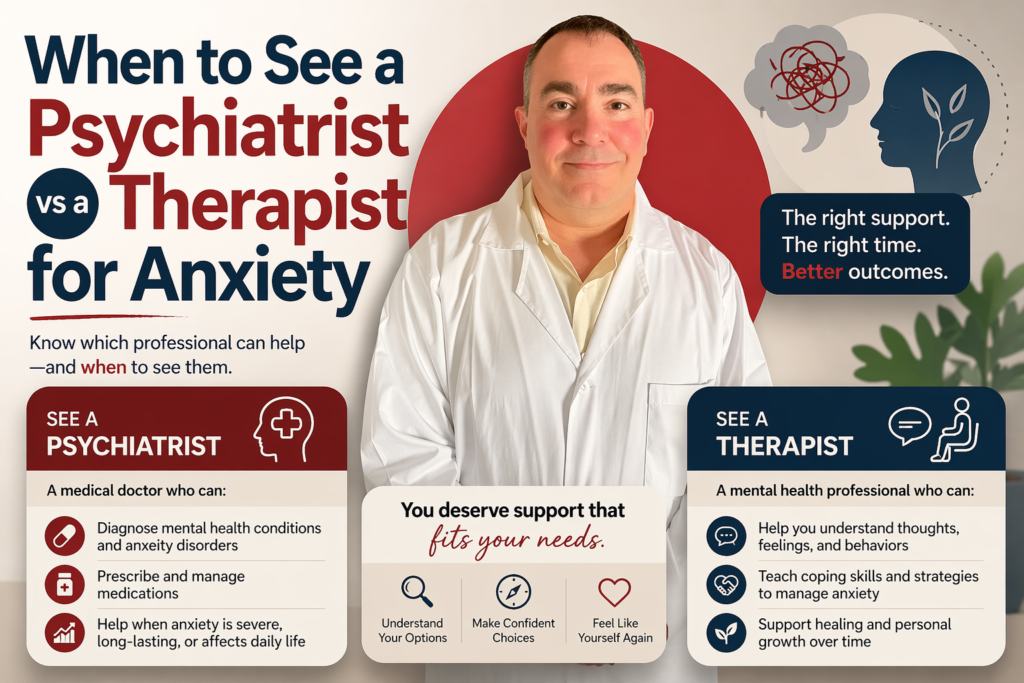
When patients in Trenton, NJ search for help with anxiety, they often face an immediate fork in the road: do they see a therapist or a psychiatrist? The answer depends on clinical factors that are worth understanding before you make the call. In many cases, the best answer is both, but if you can only start with one, here is how to think about which one.
The Core Difference: Therapy vs Medical Evaluation
A therapist’s primary tool is the therapeutic relationship and evidence-based talk therapy techniques. For anxiety, Cognitive Behavioral Therapy (CBT), which targets the thought patterns and avoidance behaviors that maintain anxiety, is the gold-standard psychotherapy. Exposure therapy is the first-line treatment for specific phobias and a core component of OCD treatment. A skilled therapist working with an anxious patient is not simply providing emotional support, they are delivering a structured, evidence-based intervention.
A psychiatrist brings a different set of tools: a medical evaluation to rule out physical causes of anxiety, a diagnostic assessment to identify the specific anxiety disorder, and the ability to prescribe medication when it is clinically appropriate. A psychiatrist also evaluates the full clinical picture, including sleep disorders, which I want to address specifically, because anxiety and insomnia have a tight bidirectional relationship that substantially changes treatment strategy.
Start With a Psychiatrist When:
- Your anxiety is severe, significantly affecting sleep, work, or daily functioning
- You have significant physical symptoms: racing heart, chest tightness, dizziness, or shortness of breath that has not been medically evaluate
- You have had therapy before that did not produce meaningful improvement
- You are experiencing panic attacks, which are uncomfortable enough to warrant a medical evaluation
- Your anxiety is accompanied by depression, ADHD symptoms, or sleep problems
- You have a family history of bipolar disorder because anxiety can be a presentation of bipolar disorder, and misdiagnosis has treatment consequences
- You are already using alcohol or substances to manage anxiety, which significantly complicates treatment
Start With a Therapist When:
- Your anxiety is mild to moderate and situational, tied to specific stressors or life circumstances
- You have no prior experience with therapy and want to try a non-medication approach first
- Your primary symptoms are cognitive and behavioral, rumination, avoidance, overthinking, rather than severe physical symptoms
- You are a good candidate for CBT and are motivated to do the work between sessions
A Note on Medication for Anxiety: What It Can and Cannot Do
Medication for anxiety, most commonly SSRIs or SNRIs as first-line treatments, is effective at reducing the baseline anxiety level and making the physical symptoms of anxiety more manageable. What it does not do is teach the brain a new relationship with anxious thoughts. That is what therapy does. This is why, for significant anxiety disorders, the combination of medication and CBT typically outperforms either alone.
I am transparent with patients about what medication will and will not address. I am also cautious with benzodiazepines, the fast-acting anti-anxiety medications like lorazepam and clonazepam, because of tolerance development and dependence risk with regular use. There are clinical situations where they are appropriate, but I discuss the risks explicitly and use them conservatively.
My Specific Advantage for Anxiety Patients: Sleep
One thing I can offer that most Trenton-area psychiatrists cannot is a sleep medicine lens on anxiety. Anxiety and insomnia feed each other in ways that are well-established in the research: anxiety disrupts sleep, and sleep deprivation lowers the anxiety threshold, creating a cycle that makes both conditions harder to treat. When I evaluate an anxious patient, I am simultaneously assessing whether a sleep component is driving or worsening the anxiety, and whether treating the sleep problem might be the most efficient intervention. This is a clinical advantage born directly from my dual certification in psychiatry and sleep medicine.
If you are in Trenton, Hamilton, or anywhere in Mercer County and looking for a psychiatric evaluation for anxiety, call (609) 588-0250 or request a TelePsychiatry appointment.