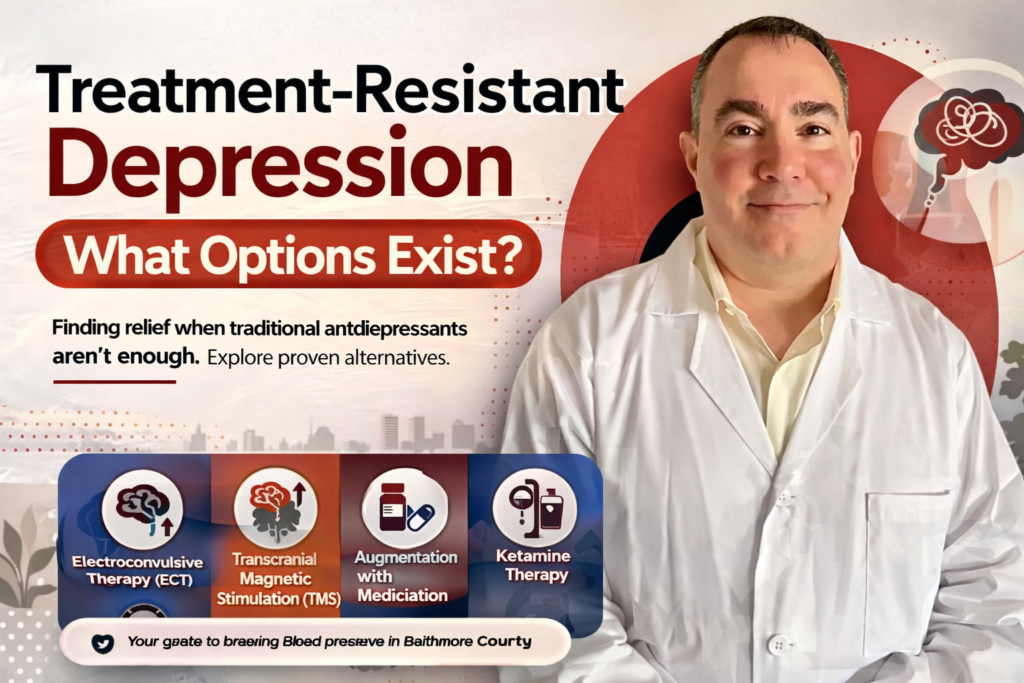
I have tried three antidepressants and none of them worked. This is one of the most common statements I hear from new patients at my Trenton, NJ practice. It is also one of the statements I take most seriously because when multiple adequate antidepressant trials have failed, we are no longer dealing with typical major depression. We may be dealing with treatment-resistant depression (TRD), and the approach needs to change accordingly.
What Is Treatment-Resistant Depression?
Treatment-resistant depression is generally defined as depression that has not adequately responded to at least two different antidepressant medications, each tried at an adequate dose for an adequate duration (typically at least 4-6 weeks at a therapeutic dose). It affects an estimated 30% of people with major depressive disorder, meaning roughly 1 in 3 patients with depression will not achieve remission with standard first-line antidepressants.
This is not a moral failing or a sign that the patient is not trying. It reflects the biological heterogeneity of depression, that ‘depression’ is actually a family of related conditions with different underlying mechanisms, and that our current antidepressants, while effective for many people, do not address all of those mechanisms.
Before Labeling It Treatment-Resistant: What I Check First
Before accepting a TRD diagnosis, I conduct a careful review of the prior treatment history, because in my experience, a significant number of apparent TRD cases involve one or more of the following:
- Inadequate dosing: many patients were tried on antidepressants below the therapeutic dose range
- Insufficient duration: four weeks at a therapeutic dose is not always enough, some patients need 8-12 weeks
- Unaddressed comorbidities: untreated hypothyroidism, sleep apnea, active substance use, undiagnosed bipolar disorder, or ADHD can render antidepressants ineffective regardless of the medication chosen
- Misdiagnosis: bipolar depression treated with antidepressants alone often does not respond well, and may worsen with mood destabilization
Addressing these factors first sometimes resolves ‘treatment resistance’ without needing more complex interventions.
Medication Augmentation Strategies
When the depression is genuinely refractory to monotherapy, augmentation, adding a second medication to an antidepressant, is a well-established approach:
Atypical Antipsychotic Augmentation
Aripiprazole (Abilify), quetiapine (Seroquel), and brexpiprazole (Rexulti) all have FDA approval as adjunctive treatments for depression. These medications work through dopamine and serotonin pathways that are not adequately addressed by standard SSRIs and SNRIs alone. They are not just ‘antipsychotics for depression’, they are acting on specific neurotransmitter systems that appear dysregulated in treatment-resistant presentations.
Lithium Augmentation
Lithium augmentation of antidepressants has decades of evidence supporting its use in TRD. It is underused in modern outpatient practice, partly because it requires blood level monitoring, but the evidence for its effectiveness is stronger than for many newer, more aggressively marketed options.
Thyroid Hormone Augmentation
T3 (triiodothyronine) augmentation has evidence in TRD, particularly for patients who are at the lower end of the normal thyroid range. This is a decision I make in the context of a patient’s full metabolic picture.
Medication Switches
Sometimes the answer is not augmentation but a switch to a mechanistically different antidepressant. SSRIs primarily work through serotonin reuptake inhibition. SNRIs add norepinephrine. Bupropion (Wellbutrin) primarily affects dopamine and norepinephrine and is often effective when serotonergic antidepressants have failed. Mirtazapine works through a different mechanism altogether and is particularly useful when sleep disruption and appetite loss are prominent.
Referral Options for Severe TRD
For patients with severe, refractory depression that has not responded to multiple medication strategies, I discuss referral options for interventional psychiatry, including:
- Transcranial Magnetic Stimulation (TMS): FDA-cleared, non-invasive brain stimulation with good evidence for TRD
- Esketamine (Spravato): FDA-approved nasal spray ketamine-based treatment administered in certified treatment centers
- Electroconvulsive Therapy (ECT): the most effective treatment for severe, refractory depression, highly evidence-based and far safer than its public reputation suggests
I am transparent with patients that my practice focuses on outpatient medication management, and that some interventional treatments require referral to specialized centers. I facilitate those referrals and remain involved in the patient’s overall care coordination.
Living With TRD: A Clinical Honest Assessment
Treatment-resistant depression is genuinely difficult, both to live with and to treat. What I tell patients is that ‘resistant’ does not mean ‘untreatable.’ It means we need a more sophisticated and systematic approach than the standard first-line trial. With a thorough evaluation, the right combination strategy, and patience, the majority of TRD patients achieve meaningful improvement. The goal is finding your version of that, not just surviving the depression.
If you have tried multiple antidepressants without adequate response, I would encourage you to schedule a formal evaluation rather than assuming nothing will work. Call (609) 588-0250 or request a TelePsychiatry appointment throughout New Jersey.